In the days leading up to La Cena della Vigilia, the Christmas Eve Feast of the Seven Fishes, Italian-American families gather to produce a dizzying array of sweets. Among them are giugiulena (joo-joo-LEH-nah), sesame-almond candies that stand as testament to Sicily’s history as a cultural junction.
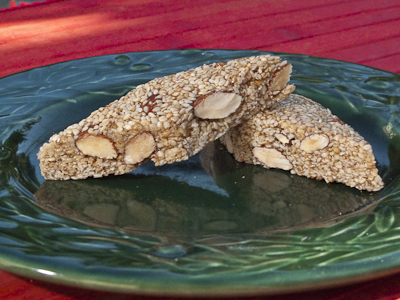
Photograph © 2008, Skip Lombardi
The island’s benign climate and central Mediterranean location attracted myriad Europeans, among them Crusaders reluctant to return to the drafty mead halls of northern Europe. In the East, European adventurers had tasted more than sesame; their campaigns in the Holy Land had brought them into contact with sophisticated Arab urban cultures. Meanwhile, Arabs had settled across North Africa and in nearby Sicily, where they introduced new crops and cultivation techniques. The Muslims of the late medieval period enjoyed peaceful participation in a polyglot society that included Jews and Christian Italians, Greeks, Normans, English, Germans, and Catalans.
Giugiulena: the Sicilian name intrigued us, and we suspected an Arabic origin even though the contemporary Arabic simsim and Italian sesamo are clear cousins. We found a clue, but no obvious answer, in the modern Spanish, ajonjoli… So we emailed our friend, fellow food-historian and linguist, Charles Perry, a longtime columnist for the Los Angeles Times.
Charles replied that both ajonjoli and giugiulena are from a less common medieval Arabic name for sesame—juljulaan. He wrote, “I’ve often wondered whether juljulaan is connected somehow with juljul, which means a small bell—a jingle bell? … al-jonjoliin was the current word in Moorish Spain. Hence, the Spanish word for sesame, ajonjoli.”
(As an aside here, we should say that Charles is one of the few people we know who can truthfully say he’s often wondered about the origin of an archaic word for sesame…)
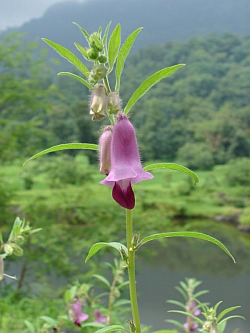
But—Charles had given us the final clue… We are gardeners, and one of us has studied plant taxonomy. So, if you happen to know what a sesame blossom looks like and if you’ve ever heard how a dry sesame seed-capsule rattles, then it’s obvious that medieval Arabs had a popular name for Sesamum indicum that vividly described two of its most distiguishing characteristics. Juljul…small bell… This photo, of one strain of sesame in the plant’s native India, says it all.
With such a multicultural pedigree, giugiulena strikes us an appropriate sweet to mark a holiday period when everyone should celebrate the prospect of peace, now and in the year ahead.
Giugiulena
Italian confectionary has traditionally been the province of women—whether they be the nuns in Italian convents, who still fashion many of the nut-based sweets from the Arab period or the Italian-American nonnas, mamas, aunts, and children gathering to make hundreds of canali, biscotti, crescenti, amaretti, and struffoli along with these jawbreakers.*
* Variations of giugiulena are widespread throughout the Mediterranean. This recipe could be described as authentically Italian, as opposed to Italian-American. However, in much of the Mediterranean, the bitter almond extract included below would be superfluous. Almond trees in the Mediterranean produce a higher percentage of bitter almonds (the taste Americans would associate with amaretto liqueur), and thus, the Americanized version counts on an extract to impart that top-note. In addition, instead of vanilla and/or the brandy, an Italian might add a few drops of grappa.
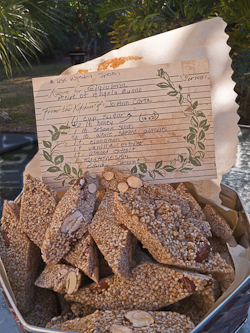
Photograph © 2008, Skip Lombardi
Although we’ve expanded the cooking instructions, this recipe is faithful to the well-used index card in the photo. It comes from Angela Munno by way of Jo-Ann Carta, both of Middletown, Connecticut.
Ingredients:
1/2 Lb. Whole shelled almonds
1 Lb. Sesame seeds
1 1/4 Cup Honey (10 oz.)
1 Cup Sugar
1 tsp Cinnamon
1 tsp Vanilla extract
1 tsp Almond extract
Grated rind of 1 Tangerine
1 — 2 oz. Brandy—optional
Preparation:
Preheat the oven to 300 F. (We use a toaster oven. If you do, stay close by to watch the almonds so they do not burn.)
Spread the almonds out on a sheet pan and place in the middle shelf of the oven. Toast for approximately 10 minutes. Remove from the oven and reserve.
Place a large sauté pan over medium heat and add the sesame seeds. In a dry pan, toast the seeds, stirring occasionally, for approximately 15 minutes, until they begin to give off a toasted aroma. Remove from the heat and reserve.
Place a 3 or 4 quart saucepan over medium-high heat and add the honey. Heat the honey until it has become liquid. Stir in the sugar to dissolve and, when the mixture begins to boil, lower the heat to medium and cook, stirring regularly, for 7 — 8 minutes—no longer. The mixture will be golden-brown in color.
Add all the sesame seeds and almonds, stirring constantly for a few minutes to incorporate them with the honey-sugar mixture. Cook for about 7 minutes, stirring regularly. The mixture will become stiff, but keep it moving in the pot. Add cinnamon and grated tangerine skin and cook for an additional 2 — 3 minutes.
Remove from the heat and stir in the vanilla and almond extracts and (optional) brandy. Continue to stir for approximately five minutes as the mixture cools. It will be quite stiff.
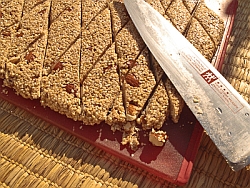
Photograph © 2008, Skip Lombardi
Pour and spread onto a wet cutting board and roll flat to a uniform half-inch thickness with a wet rolling pin.
With a sharp, wet knife, cut the candy on the diagonal to make diamond shapes or lozenges*.
* As one more demonstration of how food brings us all together: the word lozenge comes from the Arabic lawz, almond.